



















Margot Robbie arrived at the Wuthering Heights world premiere in Los Angeles wearing a jewel that instantly overshadowed her Schiaparelli gown. She appeared at the red carpet evening adorning the famed Taj Mahal diamond necklace. While it was long associated with Elizabeth Taylor, the necklace carried a 400-year old Indian history. As cameras flashed and headlines followed, a Mughal love token made another journey from imperial history to Hollywood spectacle.
The Mughal Love Story & History Behind the Diamond
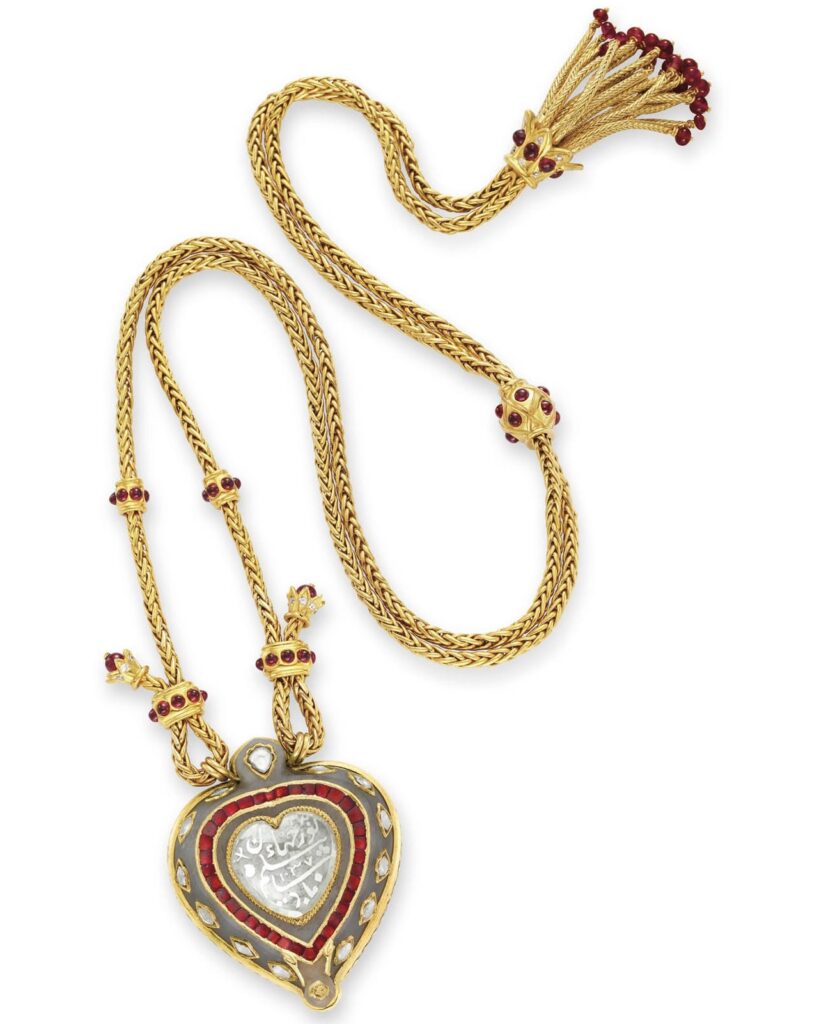
Up close, the necklace reads like a story written in stone. At its centre sits a heart-shaped diamond mounted on jade, framed with gold, rubies and roundel diamonds. The jewel was originally suspended from an Indian silk cord, a detail rooted in Mughal aesthetics, before being later refashioned with a gold and ruby chain when it entered Western hands. Inscribed in Persian on the pendant are the words “Love is everlasting,” alongside the name of Nur Jahan.
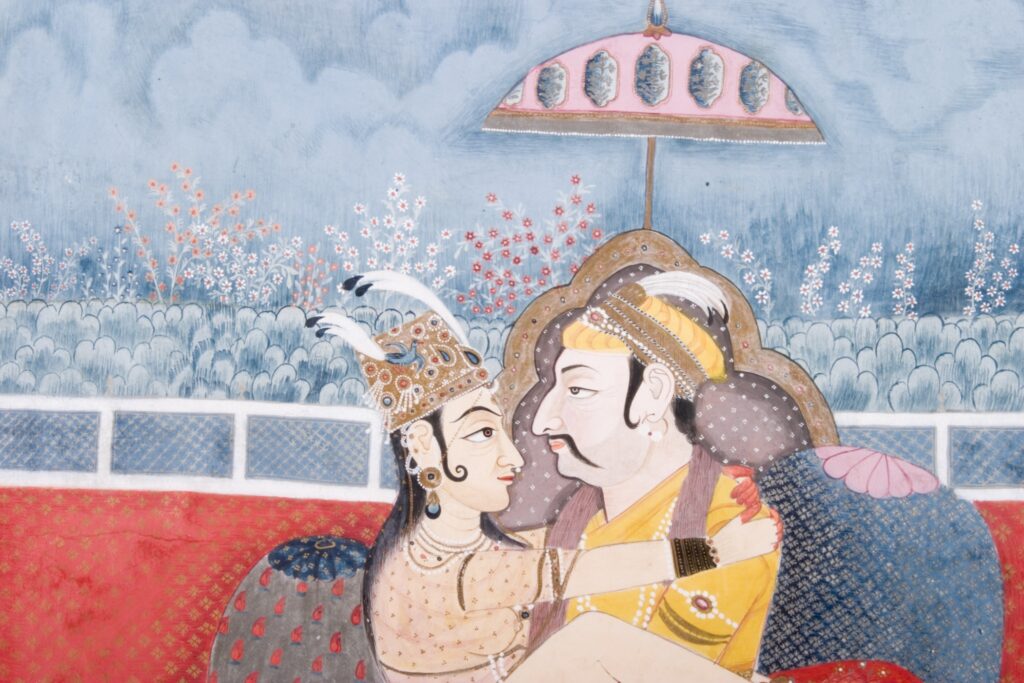
The necklace was gifted to Empress Nur Jahan by her husband, Mughal Emperor Jahangir in the 17th century. The Empress was not merely a consort but a cultural force who shaped architecture, fashion and courtly taste. The diamond was then passed down to their son, Mughal Emperor Shah Jahan. He then gave it to his most beloved wife, Mumtaz Mahal. When Mumtaz died during childbirth in 1631, the grieving emperor famously had the Taj Mahal built as a memorial in her honour and memory. It is from this lineage that the jewel came to be known as the Taj Mahal diamond. The necklace, like the mausoleum, became a symbol of imperial love that fused personal emotion and public legacy.
From Mughal Empress to Hollywood Icon
The leap from Mughal India to modern celebrity culture occurred much later and under murkier circumstances. By the 20th century, the jewel had entered the Cartier universe. The House “mysterisouly” acquired the piece and subtly reshaped it for European sensibilities. The transformation included replacing the original cord with a chain and reframing the necklace as a standalone pendant suitable for Western eveningwear. In 1972, Cartier president Michael Thomas famously presented the necklace to Elizabeth Taylor and Richard Burton at New York’s Kennedy Airport International Hotel. Burton had reportedly asked Cartier for gift ideas ahead of Valentine’s Day and Taylor’s birthday. Taylor would go on to wear the necklace on her 40th birthday and repeatedly, embedding it firmly in the mythology of her legendary romance with Burton.
When Elizabeth Taylor’s jewellery collection was auctioned in 2011, the Taj Mahal necklace sold for 8.8 million dollars, setting a record at the time for Indian jewellery. Media coverage widely referred to it as the “Elizabeth Taylor necklace,” a naming convention that persists today. While some reports acknowledged its Mughal provenance, the shorthand continued to centre its Western ownership, effectively relegating centuries of Indian history to a footnote. While the Persian inscription remained intact, the jewel’s public identity became inseparable from Hollywood glamour rather than imperial India.
Appreciation or Appropriation
This selective framing has reignited debate around cultural ownership and access, particularly in light of recent controversies involving Cartier. In 2025, Punjabi singer and global star Diljit Dosanjh reportedly requested to borrow the Patiala necklace, another Cartier-held jewel of Indian origin, for his Met Gala appearance. The request was denied, with explanations citing conservation and fragility. The refusal sparked backlash after it emerged that parts of the same necklace had previously been loaned to Western celebrities and influencers. Critics questioned why artists who represent the cultures from which these jewels originate are often denied access, while Western figures are granted visibility and prestige through the same objects.
Margot Robbie’s appearance in the Taj Mahal necklace has therefore become more than a fashion moment. It has reopened uncomfortable questions about who is allowed to wear history and under what conditions. When jewels inscribed with Indian names and Persian poetry are introduced to global audiences primarily through Western celebrities, the narrative conveniently shifts. The jewel becomes a borrowed artefact rather than a cultural inheritance. The emphasis moves from origin to ownership, from history to styling.
Luxury houses frequently describe themselves as custodians of heritage, yet custodianship without context risks becoming appropriation. Preservation must include acknowledgment, and access must be equitable. Otherwise, red carpet moments continue to reinforce old hierarchies, where South Asian history is celebrated only after being reframed through Western validation. The Taj Mahal diamond may still sparkle, but the question it carries remains unresolved. Whose story is being told, and who is left unnamed while history shines on someone else’s neck?